
How we made a new AI product the safe pick for big retailers and the easy one for small teams
An eCommerce SaaS launched its AI into a squeeze: bigger names above, cheaper AI tools below. Selling AI harder would have lost to both, so we sold what buyers wanted from it in the first place — more sales, without risking their data or time.
The starting position
- → A feature-rich eCommerce SaaS with slowing sales
- → Peak AI hype, and a flood of AI-native tools covering parts of the job
- → Buyers who wanted AI, minus the risk, the work, and the extra cost
The strategic decision
When buyers want new technology but dread what it’ll take to adopt it, every feature you explain gives them one more thing to worry about.
So ask them to change as little as possible (ideally, nothing). Promise the result, prove it fast, and address the fear out loud.
We positioned the AI product as more sales from what retailers already had — their current traffic and catalog. We put the proof before any feature, and spent time answering the biggest objections (losing control and exposing customer data).
The problem
Sales got harder in the AI wave, so they built an AI product
We’d first worked with this platform a year earlier. They had a great, proven product, which they explained feature by feature, in (a lot of) technical detail. Buyers saw more product than they needed and less of what it would do for them. So we rebuilt the positioning and rewrote the whole website around what the platform did for merchandisers.
A year later, the AI hype was in full swing. Simpler, cheaper AI tools were winning over smaller teams, big retailers were sticking with bigger names, and the hype made selling hard again.
The platform’s answer was an AI product of its own, in addition to weaving AI into some of its core features. The messaging only needed light edits to lean into AI. The new product needed much more: its own messaging foundations and a launch landing page.
The diagnosis
Everybody wanted AI, minus the risk that comes with it
The biggest competitors already sold AI-powered discovery suites (search, recommendations, personalization, the lot), and the smaller AI tools each took one slice. Almost all of them led with technology, without acknowledging the perceived risks.
Then came the comments, complaints, and fears from the client side and from retailers in general. Retailers wanted AI. Minus what seemed to come with it:
- 1. New risk: Handing an AI their customer data and their brand rules
- 2. New work: Another tool to learn, set up, and keep an eye on
- 3. New spend: A second bill, on top of the platform they already paid for
Faced with all of that, many retailers would rather wait. Because at that moment, most AI pitches sounded like a kitchen renovation. Worth it eventually, but first, months of dust while you’re still cooking dinner in there.
Our job was to make adopting AI feel like no renovation at all.
The solution
One message, two different reasons to say “yes”
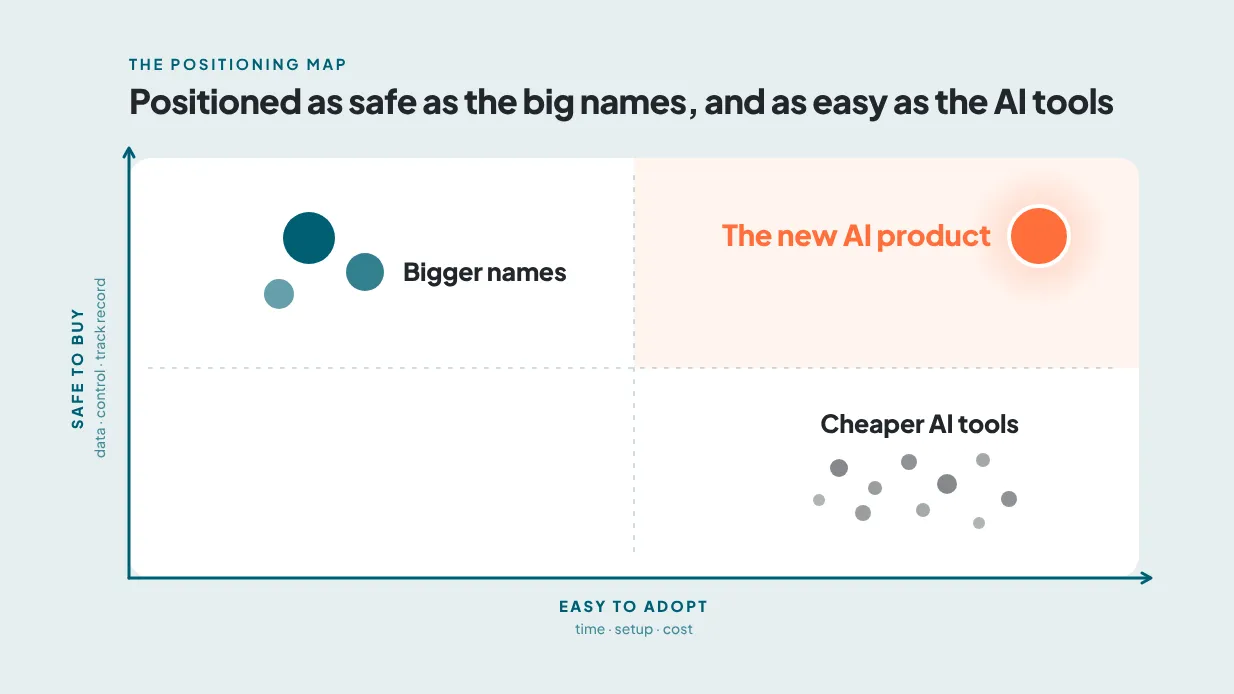
The angle answered all three costs at once. Retailers would sell more from what they already had: the visitors already coming, the catalog already built, the analytics already running.
There was no new spend beyond the tool, no new hours (it saved them), and no customer data, because the model only ever saw the catalog and product analytics.
Then we ordered the page the way a skeptical buyer thinks and evaluates. First the promise, then hard proof, then the benefits that are harder to count, then the features, framed by the pain they fix, and then the two fears, answered head-on.
Together, the angle and the order did two jobs:
- • For big retailers, it made our client the safe pick: proof from brands they recognized, humans in control, customer data kept out
- • For smaller teams, it made our client the easy pick: nothing to rebuild, nothing to train from scratch, hours handed back
The walkthrough
Calm, confident copy for a skeptical, uneasy buyer
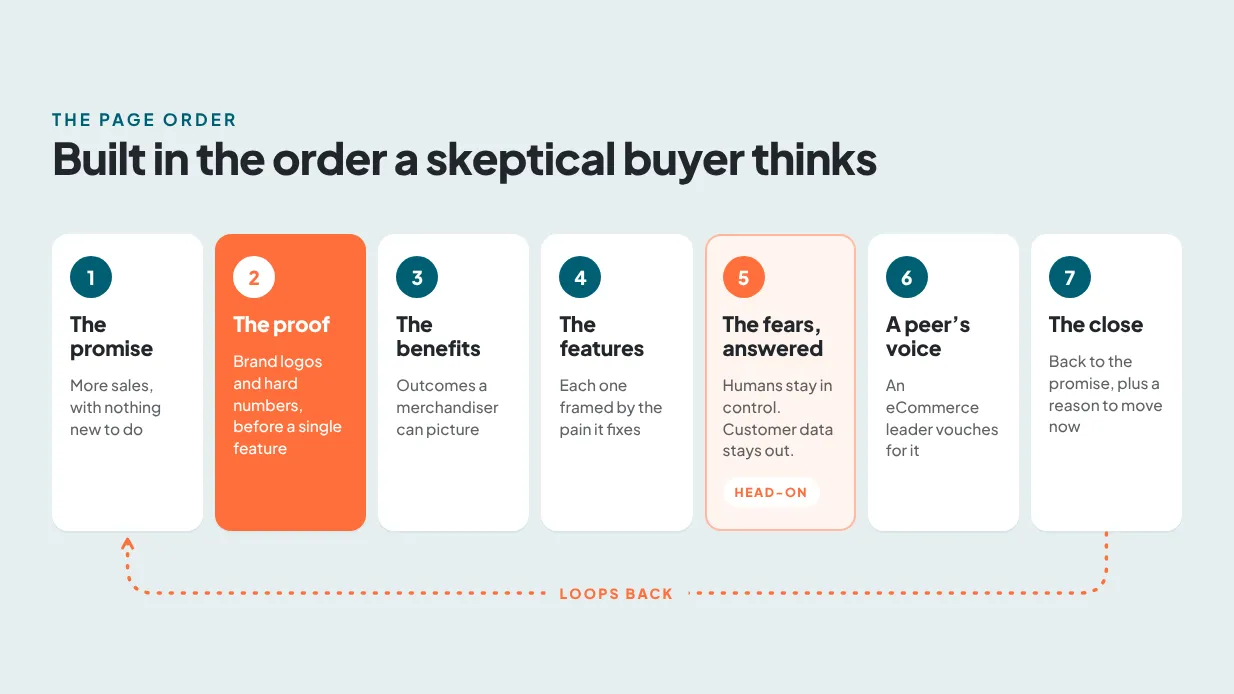
Most competitors were (very) loud about AI. Our buyer, by contrast, was uneasy, reserved, and even afraid of it. They wanted AI, but they were still very cautious.
So our copy needed to be calm, with plain promises, real numbers, and the scary parts addressed in broad daylight.
More sales, without changing how they work
The headline promises more sales from the visitors the retailer already gets. They don’t need a new channel, budget, or habit to get there. The AI only shows up in the subhead, as the how, and by then the reader already wants the result.
This is one of Category North’s core principles — Refuse the wrong fight — in practice. A fight over whose AI is “better” goes to the companies built around nothing else but AI. A promise of more sales from what you already have? Nobody else was making it.
Putting the hard numbers right under the promise
The platform had two kinds of proof: enterprise retail brands on the customer list, and three hard numbers from them. So both went right under the headline, before a single feature appeared.
A big retailer’s first doubt is whether this works for a company their size. This gets answered in the first scroll. We put the evidence where doubt is most dangerous.
Benefits so relevant that people can visualize them
Anyone who’s run an online store has felt it when a shopper lands on a sold-out product and leaves. The section’s headline puts that moment next to the one they want — a confirmed order — as an almost-visual result of what the product does.
The benefits that are harder to put a number on come right after, written as outcomes describing exactly what the product changes. What our client’s platform does under the hood can wait for the features section.
Not waiting for the demo to address the fears
Two questions kept coming up around AI: will it override our brand rules, and is our customer data safe? We gave each one a headline of its own. The human-in-control section answers the first one before the website visitors even ask for it.
The privacy section opens with the promise, then backs it up: the model works from the catalog and product analytics, never from customer profiles.
Ending on the same promise, with a reason to move now
The close goes back to where the page started: revenue from the data they already collect. Then it adds the one thing the hero didn’t — urgency. This way, waiting changes from the safe option to the risky one.
The result
Easier sales, and messaging that outlived the hype
We can’t share names or numbers here. We can share what changed: more leads and more deals. Selling and negotiating got easier too because the website copy pitched this AI product as more orders from shoppers who’d visit anyway, which made its investment easy to justify.
The messaging went live a few years ago, in the middle of the AI rush. Today it’s running almost word for word, and still doing its job. In AI years, that’s a small eternity.
The next step
Give your buyers a reason to quit shopping around
This client launched its AI into a crowded market and still pulled ahead once we took away buyers’ biggest fears. If your product is good but keeps losing to competitors, we’ll find what’s stopping your buyers and rebuild your positioning and copy to answer it.
Book a consultationIdentify the messaging gap holding you back, whether you hire us or not.