
How we positioned a pre-launch SaaS to compete with Buffer and Hootsuite
A martech SaaS with no users needed to break into a commoditized market dominated by Buffer, Hootsuite, Later, and Publer. We couldn’t win on features or proof, so we focused on the real voice of the right users.
The starting position
- → Entering a highly commoditized market with zero proof and no users
- → Giants owned search results, ad space, and buyers’ awareness
- → All obvious positioning angles and segments were already claimed
The strategic decision
If you’re up against giants and already-established alternatives, you can’t outspend them. You also can’t beat them on features or proof.
What you do is identify the messaging gap in the market (there’s always one). Then, own the gap in a way no other competitor can, because they’re too big to follow you there.
For this martech SaaS, we built the entire messaging system out of the buyers’ own words.
The problem
Dozens of established competitors and no head start
The client was a pre-launch social scheduler out of Australia, built from scratch after the founder got fed up with how similar tools advertised time-saving and still wasted hours of his time each week.
His promise was easy to say and hard to own: make social media scheduling across platforms as simple as ordering a pizza.
Social media management is one of the most crowded categories in software. The giants dominated the search results, the review sites, and the audience’s minds. Our client had zero users, no logos to show, and no case studies to draw proof from.
Every standard way to stand out was already closed.
The diagnosis
The three obvious fights were already lost
Following our Six Refusals approach, deciding which fight is worth having is where we always start. And here, the three obvious angles were clear dead ends.
1. Features were a tie. The product was fast and easy to use, with all essential features. So was Buffer. So was Hootsuite. And most of the other tools. In this category, “ease of use” is not an edge, but a price of entry. Whatever we thought of claiming, somebody else already did.
2. Proof didn’t exist. The usual fix when features can’t differentiate you is social proof. But you can’t out-testimonial competitors when your testimonial section is an empty box.
3. The budget was limited. And even if it wasn’t, outspending names like Later or Publer? You’d have better chances of beating Novak Djokovic in the Australian Open.
So we went looking for something the established giants couldn’t do, and found it in two places they weren’t even looking.
The solution
The positioning came from the users’ own words
We reverse-engineered competitors’ copy across the industry and found the same habits everywhere:
- • They sold features instead of what those features hand you back on a busy Tuesday
- • The writing was polished and personality-free, trying a “catch-them-all” approach
Every competitor site blurred into one. And none of them named the thing users still complained about — the hours that cross-platform posting eats alive.
Next, we focused on the users most likely to switch. Smaller teams. Younger people.
We actually read what they wrote on Reddit, X, and G2 — what annoyed them, what they cared about, and the exact words they used to explain it. Mining customer language isn’t a new thing (Copyhackers have been preaching about it for what feels like decades). But none of the competitors bothered to do it.
We did.
It gave us the one position no alternative could chase us into: a voice. Confident, a little sassy, tuned to how these users actually talk to each other.
Big platforms can’t write that way — they have too many stakeholders, too much to lose, so whatever personality they used to have gets sanded off. Our client had no such limitations.
The walkthrough
Sassy, but never for the sake of sounding sassy
If you’re using sass to position a company, it’s easy to get carried away. Every joke had to sit on a real, checkable claim. That's what kept the sass from floating free.
Say the “standard” thing, but make it land harder
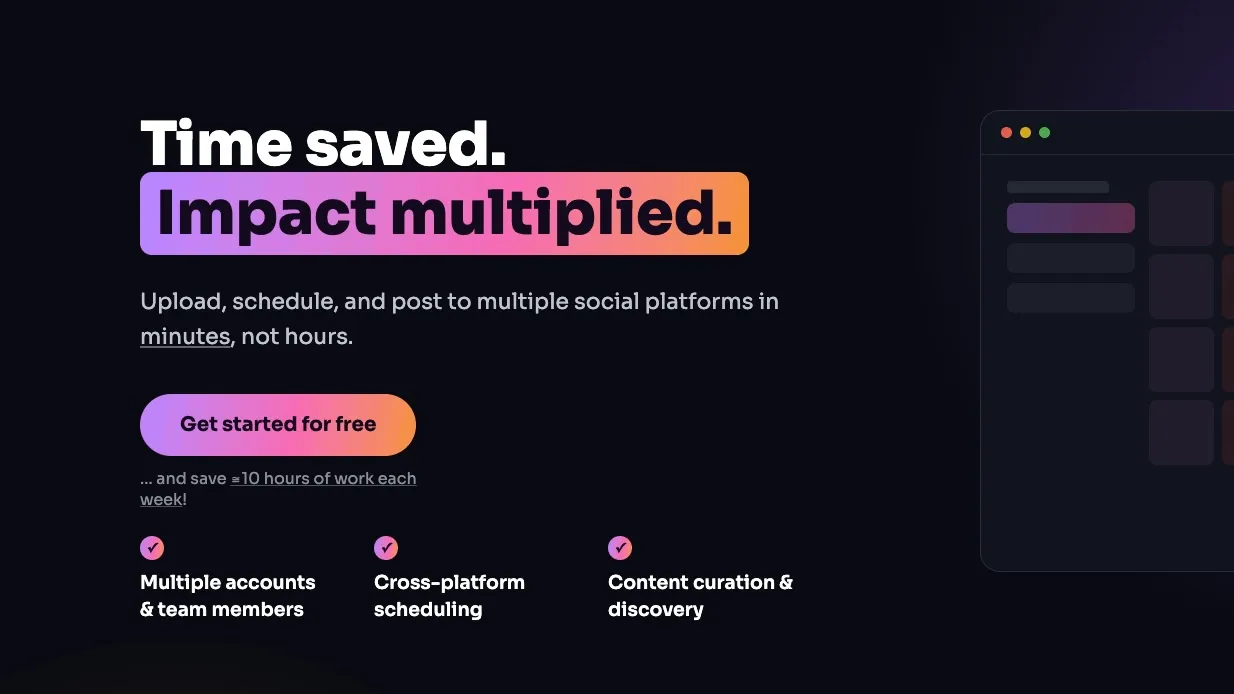
Most of the alternatives opened with the “easy to use” claim. We opened with the outcome. Four words, two beats, no throat-clearing. It says nothing about what the product is and everything about what it does for you, which is the only thing a buyer wants in the first second.
We used the microcopy under the button to lower prospects’ objections. There were no testimonials, so we gave them math. And with ≅ before the number, we made the promise concrete.
Then the logo bar, except there were no logos. The line fills the space with attitude and tells you who the product’s for, in their voice. A marketing committee at Hootsuite could never ship a line like that, which was exactly the point.
Turn the benefit into the ICP’s actual life
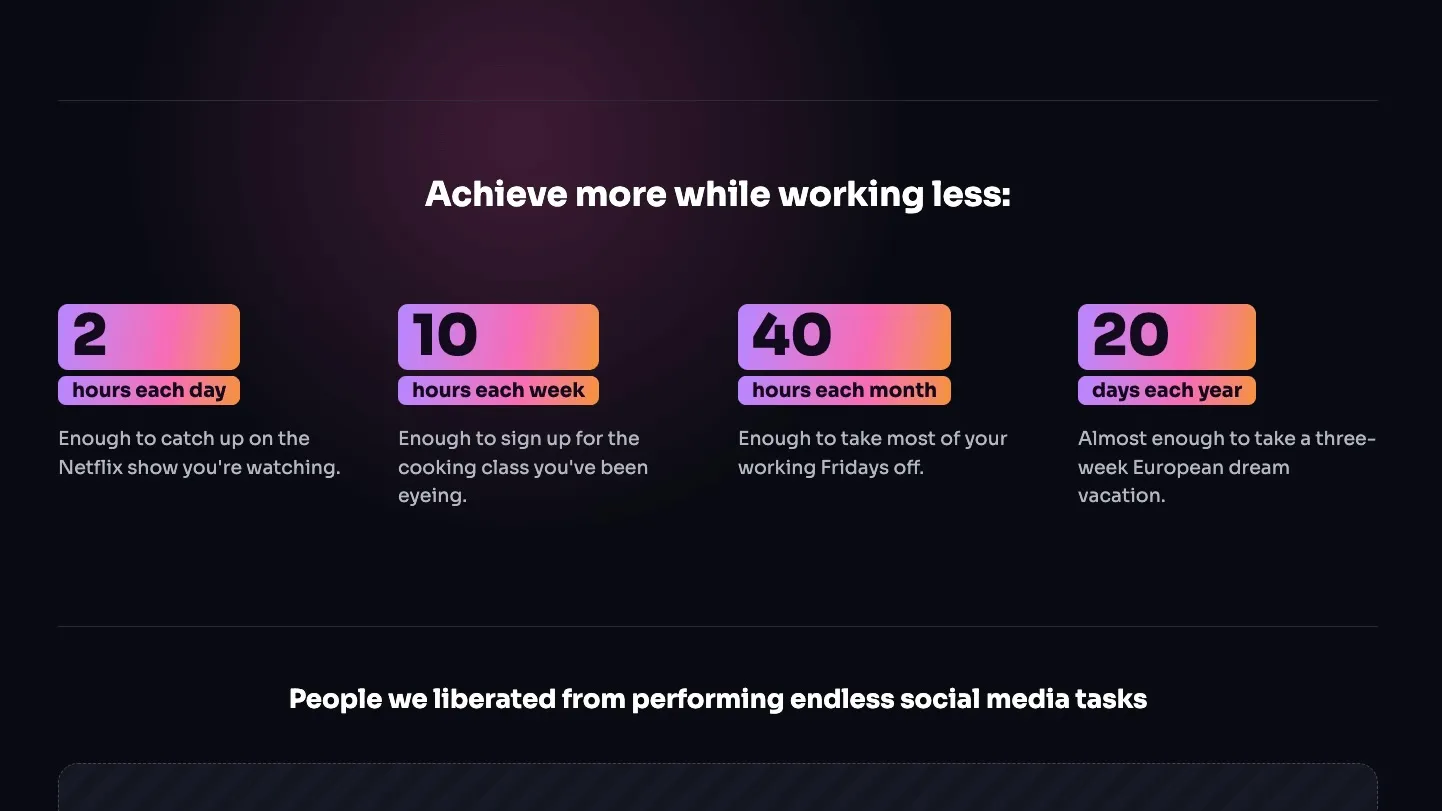
It’s the payoff, in the reader’s most important currency, time. This audience doesn’t feel “efficiency gain” or “revenue increase.” But they do feel a free Friday afternoon. Something nobody else in the category promised them.
We took the founder's own pizza idea and made it the mechanic:
“You’re a few steps away from working ≅40 hours less this month:
Step 1: Order a pizza (with or without pineapple — we don’t judge!)
Step 2: Schedule an entire month’s worth of posts before the doorbell rings
Step 3: Enjoy your pizza, …”
Be memorable when they forget everyone else
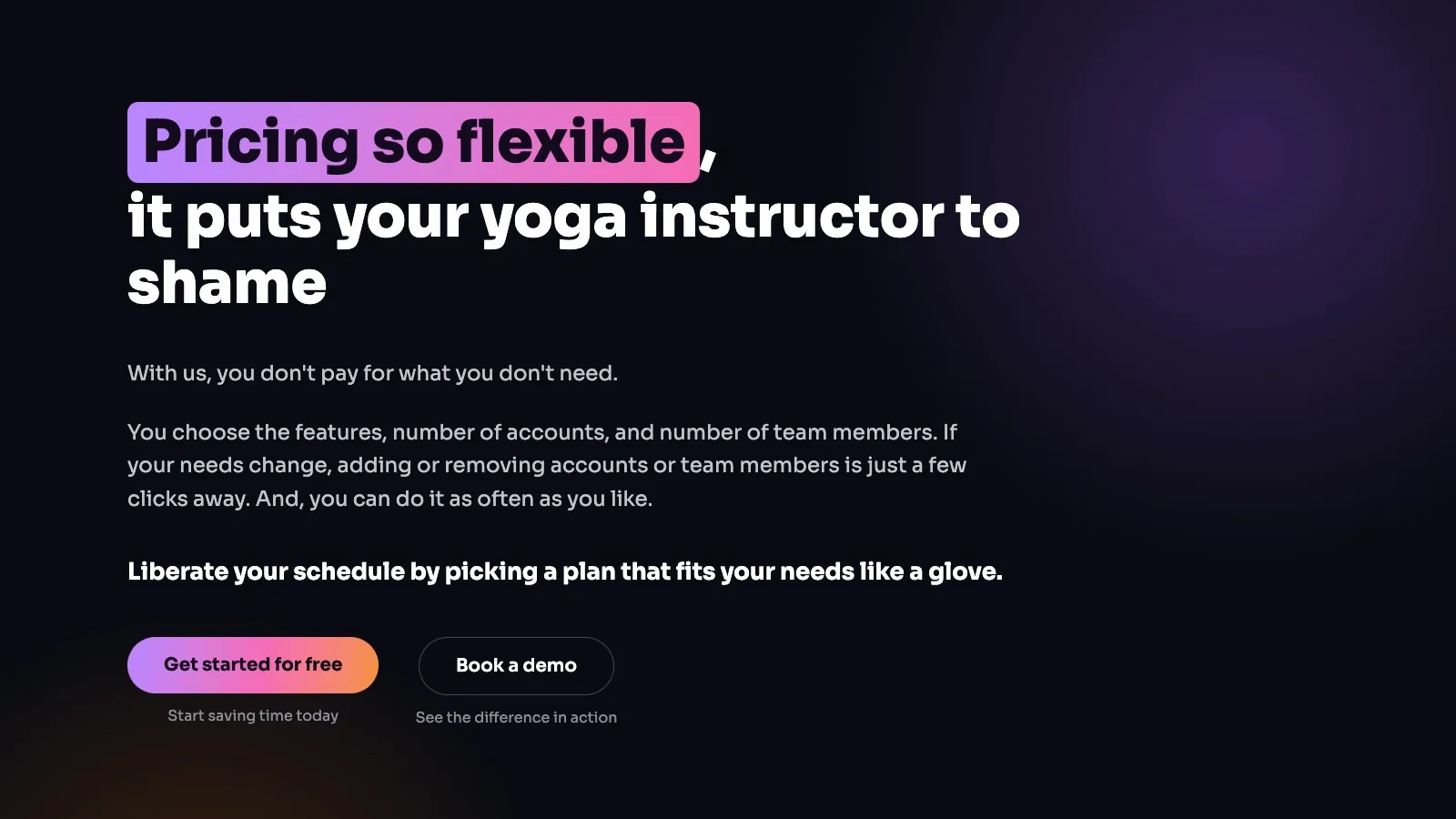
“Flexible pricing” is a claim nobody remembers. The one above is difficult to forget. And when you’re being evaluated against 10+ brands that sound alike, being remembered wins the deals.
The feature pages run on the same instinct. Bulk uploading isn’t labeled “Bulk uploading” — it’s “XXXXXL uploads”. The scheduling page opens with “Goodbye, manual posting!,” naming the enemy instead of listing specs.
Our martech client couldn’t be the biggest, the most proven, or the best-funded alternative. But it could be the only one that sounded like the actual users. And when you're new, being remembered is the whole game.
The result
A growth angle no one could imitate
Sadly, the launch got postponed, then postponed again. Then again. So we don’t have revenue numbers to share.
Instead, this project became the portfolio sample we sent to SaaS prospects over the years. At least five clients named this exact project (and the thinking behind it) as the reason they hired us. Two asked us to bring “that same energy” to their brand. We said “no,” of course, because that “energy” came out of this audience’s words. Your buyers talk differently, and that’s the entire point.
The next step
Find the position your competitors can’t copy
This client had zero users and an army of bigger competitors — and still ended up sounding like the only one in its category. That was hard mode. With traction and proof they never had, you’re not playing on hard mode.
Book a consultationIdentify the messaging gap holding you back, whether you hire us or not.